
Clubs & Facilities
Fewer Court Walks, Fewer “Are You Open?” Calls: What Camera Court Status Does for Club Staff
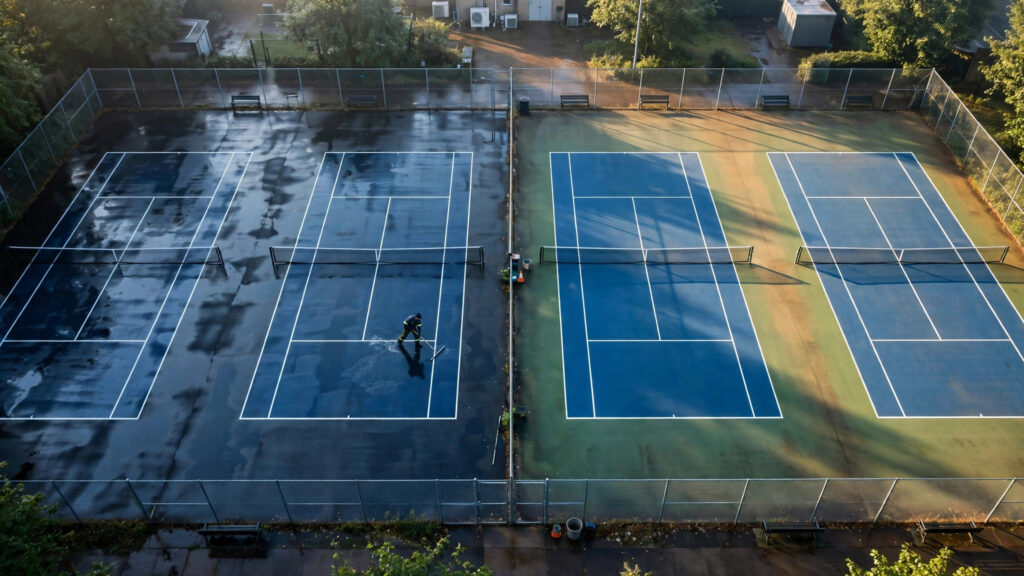
Every rainy morning at a tennis club begins with the same two sounds.
The first is shoes on wet pavement: a staff member walking the courts, squeegee in hand, checking puddles, pressing a palm to the surface, squinting at the shaded corner of Court 5 that is always the last to dry.
The second is the phone. It starts before the walk is finished and it does not stop: Are you open? Is the 9 o’clock clinic on? Should the team still come? Every caller gets a slightly different answer, because the honest answer — “some courts are fine, some aren’t, and we’re still checking” — doesn’t fit in a phone call.
That gap between what staff know and what they can say is where most rain-day frustration lives. And it’s exactly the gap a camera-based court status system is built to close.
The court walk is a ritual. It’s also a bottleneck.
The traditional post-rain routine hasn’t changed in decades. Someone walks every court. They judge standing water by eye, damp patches by feel, and drying time by experience. Then they make one decision for the whole facility — open or closed — because one decision is all a walk can produce.
Two things go wrong with that.
First, it’s slow. A twelve-court club can burn the best part of an hour on inspection while members circle the parking lot. Second, it’s blunt. Courts don’t dry together. The two in full sun may be ready an hour before the shaded one by the fence — but a blanket “closed” benches them all, and a blanket “open” sends players onto a court that’s still slick in the corner nobody checked.
One screen, one answer per court
WetCourt Vision takes a different approach: instead of sending a person to look at every court, it reads the courts through the cameras most clubs already have.
Each court gets its own status, read from its own camera image — standing water, damp patches, shade — and presented the way staff actually talk about courts:
- Ready
- Drying
- Check first
An hour after a morning shower, one screen might read: Courts 1 and 2 ready, Court 3 drying, Court 4 check first, Court 5 still wet in the shade. That’s not a weather forecast. That’s a court sheet.
The practical change for staff is simple: the walk becomes the exception, not the routine. You walk out when a court says “check first.” Everything else, you can see from the desk — and the status keeps updating as the surface dries, so the 9 a.m. answer can honestly become a different answer at 10.
Staff stay in charge — deliberately
This is the part that matters most, and the part WetCourt is careful about: the system suggests; people decide. It proposes ready, drying or check first. Staff make the call on every court, every time.
That division of labour is honest about what a camera can and can’t settle. A camera can see standing water, damp patches and shade patterns. It cannot feel traction under a shoe, and it cannot judge the firmness of a clay court the way a groundskeeper’s hand can. A tool that knows its limits — and routes the doubtful cases to a human with a “check first” — is worth more than one that pretends to certainty.
The second win: one answer everyone can share
Ask any front desk what actually eats a rain day and it isn’t the squeegee. It’s the communication: the calls, the texts, the captain asking for the whole team, the member who drove forty minutes on a rumour.
A per-court status gives staff one clear answer per court that they can share with members and teams — the same answer on the phone, in the group chat, and at the desk. For team tennis, that’s the difference between a captain relaying a guess (“club says maybe by noon?”) and a captain relaying a status (“Courts 1–2 ready, 3 drying, next check at 10”). League nights stop being decided by whoever phones first.
What it asks of a club: almost nothing new
Two practical points, because club staff have heard big promises before:
- No new hardware. It works with the outdoor cameras clubs already run — if you can look at the court on a screen today, that’s usually enough.
- It reads surfaces, not people. Faces are blurred before any image is processed. The system is looking at water, not at your members.
And while tennis is the home case, the same per-court logic covers pickleball and padel, clay courts (with watering taken into account), and beyond the fence — ball fields, turf and sand volleyball all get their own waterline too.
The bottom line for staff
Nobody got into club work to spend mornings as a human rain gauge. The court walk will never disappear entirely — nor should it, because judgment is the job. But judgment is wasted on courts that are obviously ready and obviously wet. It’s needed on the one that says check first.
Fewer court walks. Fewer “are you open?” calls. One clear answer per court, made by your staff, backed by what the camera actually sees.
Give your staff one clear answer per court. Clubs can join the WetCourt pilot — and parks departments and camera networks can talk to the team — at wetcourt.vision.
Build the team behind the player
Get a practical plan for coaching, fitness, recovery, travel and sponsors, or find courts and partners and run your club with the tools in our network.
Request consultingTry the Team BuilderFind a partnerRun your club